
Security and Protection for Embedded Systems
2026-09-22 09:13:48 | Motor Sürücüsü | Yazar:Fandou Tech
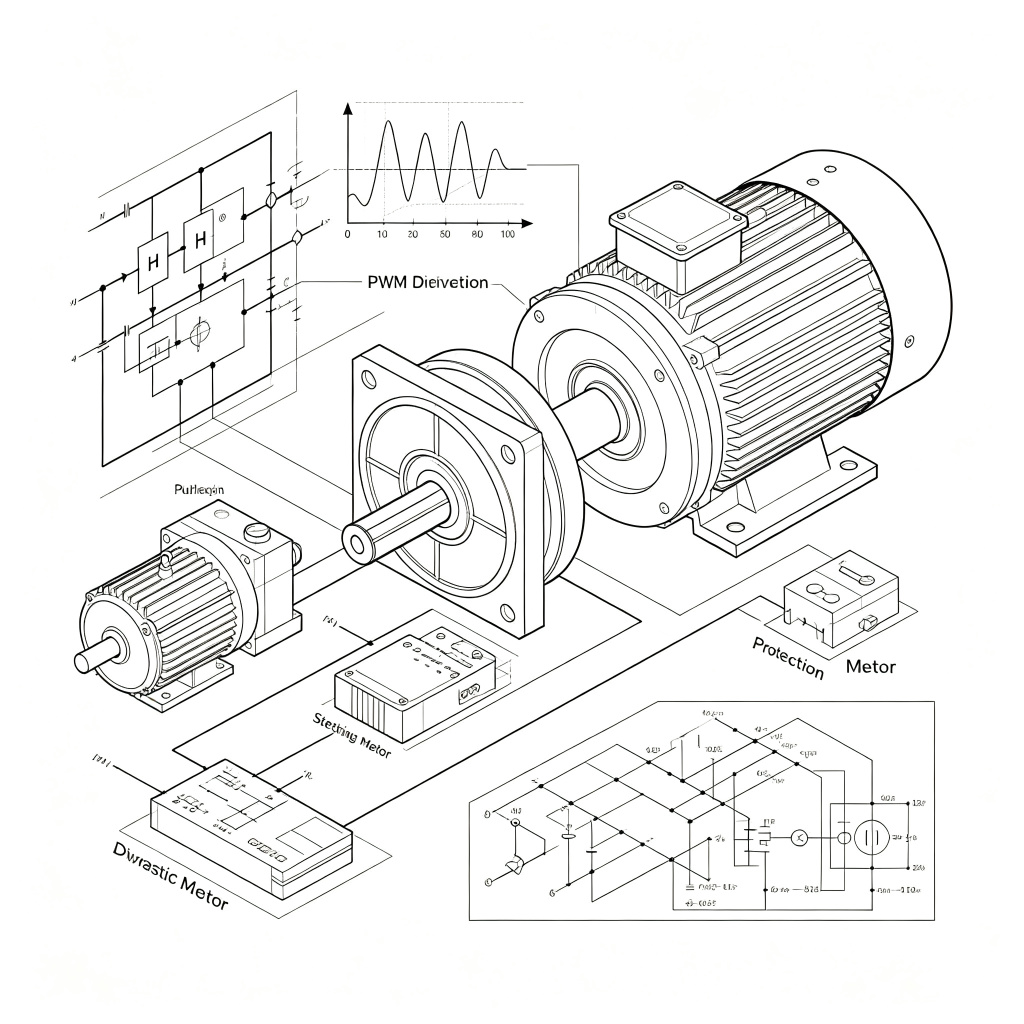
Motor Driver Circuit Design: H-bridge and PWM Speed Control:
1. H-bridge Drive Principle:
- Four switching transistors form H-bridge structure
- Control motor forward and reverse through different switch combinations
- Control speed through PWM duty cycle adjustment
- Freewheeling diodes provide current path
2. H-bridge Types:
- Discrete Components: Low cost, flexible design
- Integrated IC: Small size, high reliability
- Half-bridge + Half-bridge: Suitable for dual-channel drive
- Full-bridge Drive: Suitable for single-channel high power
3. PWM Speed Control Technology:
- Frequency Selection: Above 20kHz to avoid noise
- Duty Cycle: 0-100% corresponds to speed range
- Dead Time: Prevent upper and lower transistors from conducting simultaneously
- Feedback Control: Encoder closed-loop speed control
4. Protection Circuit Design:
- Overcurrent Protection: Sampling resistor + comparator
- Overvoltage Protection: TVS diode + Zener diode
- Overheat Protection: NTC temperature detection
- Reverse Connection Protection: Diode or MOS transistor
5. Application Scenarios:
- DC Motors: Small fans, toy cars, robots
- Stepper Motors: 3D printers, engraving machines
- Brushless Motors: Hair dryers, vacuum cleaners
- Servos: Drones, robots
6. BOM List:
- Driver IC: DRV8833, L298N, A4950
- MOS Transistor: AO3400, SI2302
- Diode: 1N5819 Schottky
- Capacitor: 100nF, 10uF
- Resistor: Sampling resistor, pull-up resistor